L'API Temp Mail est devenue un composant essentiel pour les équipes d'ingénierie modernes cherchant à éliminer le dernier goulot d'étranglement manuel dans les processus CI/CD : la vérification des e-mails. Alors que l'infrastructure peut être provisionnée en quelques secondes, les dépendances liées aux e-mails restent obstinément persistantes, déclenchant souvent des filtres de détection de bots et des pare-feu applicatifs (WAF) agressifs qui entraînent des bannissements de compte immédiats et l'échec des pipelines de test.
Selon le rapport DORA de Google Cloud, les équipes les plus performantes mettent l'accent sur les tests automatisés à haute fréquence comme moteur clé de la performance de livraison logicielle. Cependant, les systèmes de messagerie hérités, conçus pour des yeux humains et non pour une logique pilotée par machine, créent un décalage structurel. L'utilisation d'une API Temp Mail programmable permet de redéfinir l'e-mail comme une ressource sans état et hautement fiable, permettant aux développeurs de contourner les limites de débit et les indicateurs de « domaine de faible qualité » qui bloquent généralement les flux de travail automatisés.
Cet article explore comment intégrer une infrastructure de boîte de réception jetable dans les environnements d'assurance qualité (QA) et les systèmes pilotés par l'IA pour atteindre une automatisation à 100 % sans la charge opérationnelle liée à la gestion de serveurs de messagerie.
Le problème : les dépendances e-mail bloquent l'automatisation
Les pipelines logiciels modernes sont conçus pour la vitesse et la répétabilité, pourtant la vérification par e-mail continue de se comporter comme un composant hérité au sein de systèmes par ailleurs modernes. Alors que l'infrastructure, les déploiements et les environnements de test peuvent être provisionnés à la demande, les flux de travail e-mail restent souvent externes, persistants et difficiles à contrôler, créant un décalage structurel entre l'ingénierie axée sur l'automatisation et les protocoles axés sur la communication.
Les tests automatisés restent bloqués en attendant l'accès à la boîte de réception.
Les suites de tests de bout en bout s'interrompent fréquemment pour vérifier si un e-mail de confirmation est arrivé, forçant les scripts à interroger des boîtes de réception partagées ou à dépendre d'une validation manuelle. Cela introduit des délais imprévisibles et compromet le déterminisme que les tests automatisés sont censés garantir.
Les boîtes mail QA partagées créent des collisions de données.
L'utilisation d'une seule boîte mail pour plusieurs exécutions de tests entraîne un chevauchement des messages, des liens de vérification dupliqués et des difficultés à identifier quel e-mail appartient à quelle session. Sans une isolation appropriée de l'environnement QA, les tests parallèles deviennent sujets aux erreurs et difficiles à mettre à l'échelle.
La création de comptes à grande échelle nécessite des identités uniques.
À mesure que les organisations augmentent leur maturité en matière d'automatisation, la gestion des données de test — et non du code applicatif — devient un goulot d'étranglement majeur. Les recherches du secteur montrent que les équipes qui automatisent les flux de données de test peuvent accélérer les cycles de développement de 58 %, soulignant à quel point la génération d'identités et le provisionnement de données affectent directement la vitesse de livraison. La génération d'identités basée sur l'e-mail, lorsqu'elle est traitée manuellement, devient une contrainte similaire.
Les domaines « catch-all » introduisent une charge opérationnelle.
Maintenir une configuration e-mail « catch-all » personnalisée signifie gérer les enregistrements MX, le stockage, le filtrage anti-spam et la logique d'analyse — en exploitant essentiellement un serveur de messagerie léger juste pour prendre en charge les tests. Cela ajoute de la complexité à ce qui devrait être un composant d'infrastructure de test jetable et évolutif.
Les fournisseurs traditionnels déclenchent des limites de débit et la détection de bots.
Des services comme Gmail sont optimisés pour une utilisation humaine, pas pour des flux de travail automatisés. Les tentatives d'inscription à haut volume, l'interrogation répétée des boîtes de réception ou les modèles d'accès par script peuvent rapidement entraîner des limitations, des défis CAPTCHA ou des requêtes bloquées.
Ces problèmes ne sont pas causés par un manque d'outils, mais découlent d'une inadéquation entre les systèmes de messagerie hérités et les besoins de l'automatisation moderne. Pour parvenir à une infrastructure de test réellement évolutive, les équipes de développement doivent traiter l'e-mail non pas comme un canal de communication manuel, mais comme une ressource programmable pouvant s'intégrer proprement dans les flux de travail automatisés.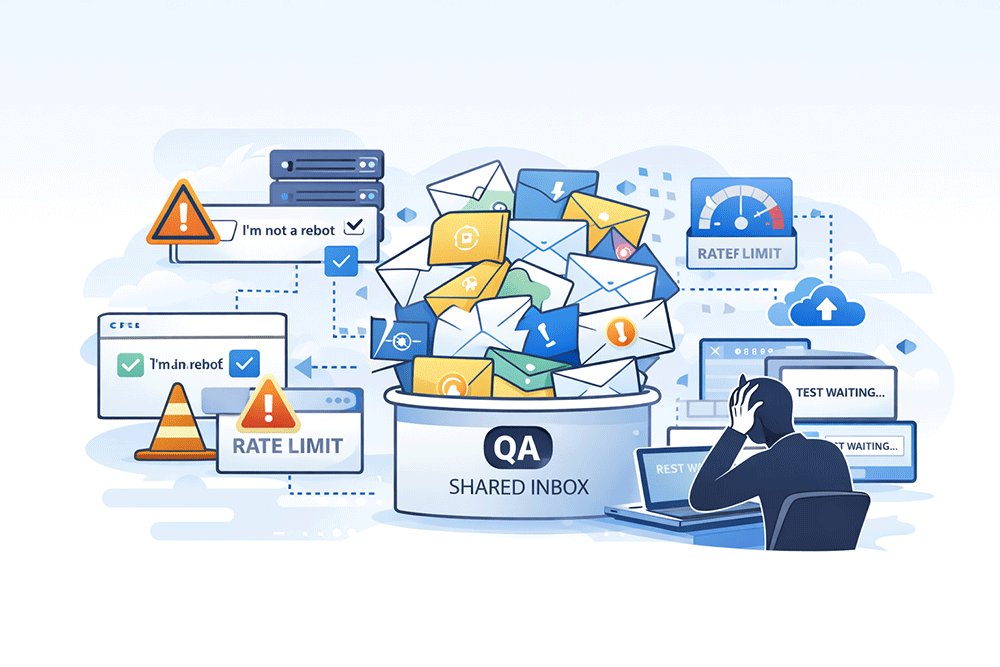
Qu'est-ce qu'une API Temp Mail ? (Définition pour développeurs)
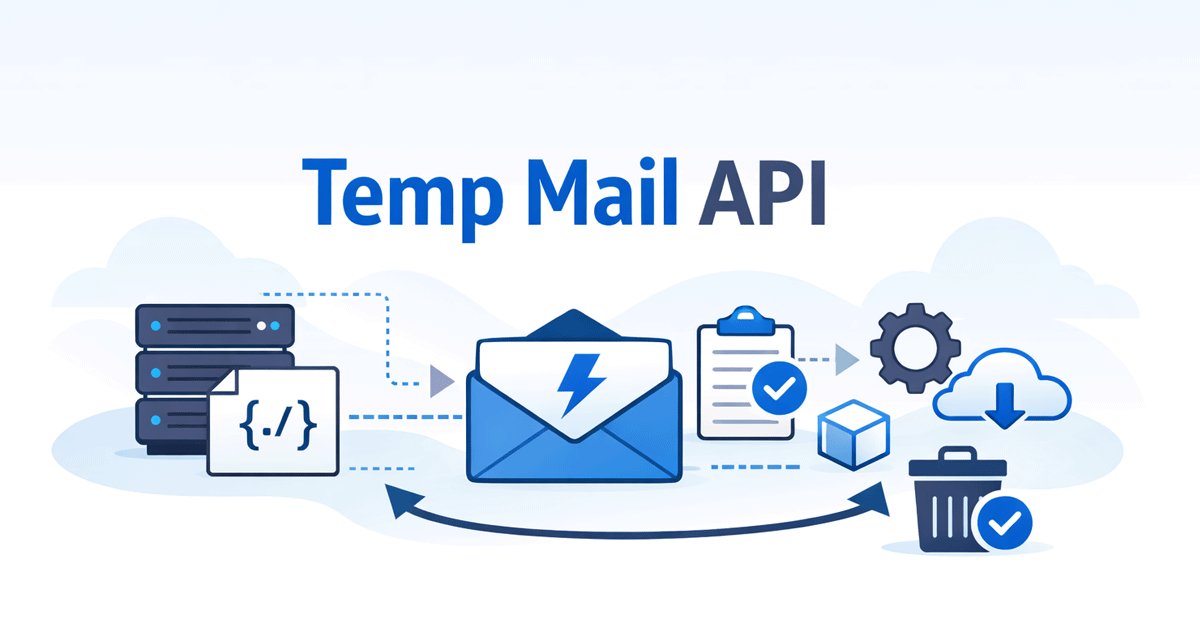
Une API Temp Mail n'est pas une boîte de réception, c'est une couche d'infrastructure pour générer et gérer des identités e-mail éphémères. Au lieu de fonctionner comme une boîte mail traditionnelle conçue pour l'interaction humaine, elle opère comme un composant programmable au sein de systèmes automatisés, permettant aux applications de créer, surveiller et supprimer des adresses e-mail dans le cadre d'un flux de travail contrôlé.
Le provisionnement de boîtes de réception à la demande permet aux développeurs de générer des adresses uniques instantanément pour chaque exécution de test, simulation d'utilisateur ou environnement. Aucune préconfiguration n'est requise, ce qui permet de mettre à l'échelle la création d'identités de manière dynamique dans le cadre d'une infrastructure d'e-mail temporaire moderne.
La récupération programmatique des e-mails permet aux applications de recevoir des messages via des appels API, des points de terminaison d'interrogation ou des webhooks. Cela transforme l'e-mail d'un point de contrôle manuel en données lisibles par machine, faisant de la boîte de réception une boîte de réception programmable qui s'intègre naturellement dans les pipelines CI/CD ou les scripts d'automatisation.
Le cycle de vie d'identité sans état garantit que chaque adresse générée n'existe que pour la durée d'une tâche spécifique. Comme ces identités sont éphémères, elles éliminent la contamination croisée entre les tests et suppriment le besoin de stockage à long terme, s'alignant sur les modèles de test distribués et conteneurisés.
L'automatisation de l'analyse de vérification permet aux systèmes d'extraire des mots de passe à usage unique, des liens d'activation ou des données transactionnelles sans intervention humaine. Cette capacité est critique pour les tests de vérification par e-mail, où la validation doit se produire instantanément et de manière fiable au sein des flux automatisés.
Le contrôle de l'environnement jetable donne aux équipes la capacité d'isoler, de gérer et de détruire des boîtes de réception dans le cadre d'un cycle de vie répétable. Chaque boîte mail éphémère peut être liée à une session, un cas de test ou une expérience, assurant une séparation propre des états entre les environnements.
En traitant l'e-mail comme une ressource jetable et programmable plutôt que comme un canal de communication persistant, une API d'e-mail jetable s'intègre parfaitement dans les architectures de développement et de test évolutives.
Cas d'utilisation en entreprise : support de domaine personnalisé et tests évolutifs
Bien que les domaines publics soient suffisants pour des scripts de base, de nombreuses plateformes bloquent désormais les suffixes temporaires bien connus. C'est là que le support de domaine personnalisé devient essentiel. En utilisant une API d'e-mail temporaire privée pour les besoins de l'entreprise, les organisations peuvent utiliser leurs propres domaines « propres », garantissant que les e-mails automatisés contournent les filtres anti-spam stricts et les WAF.
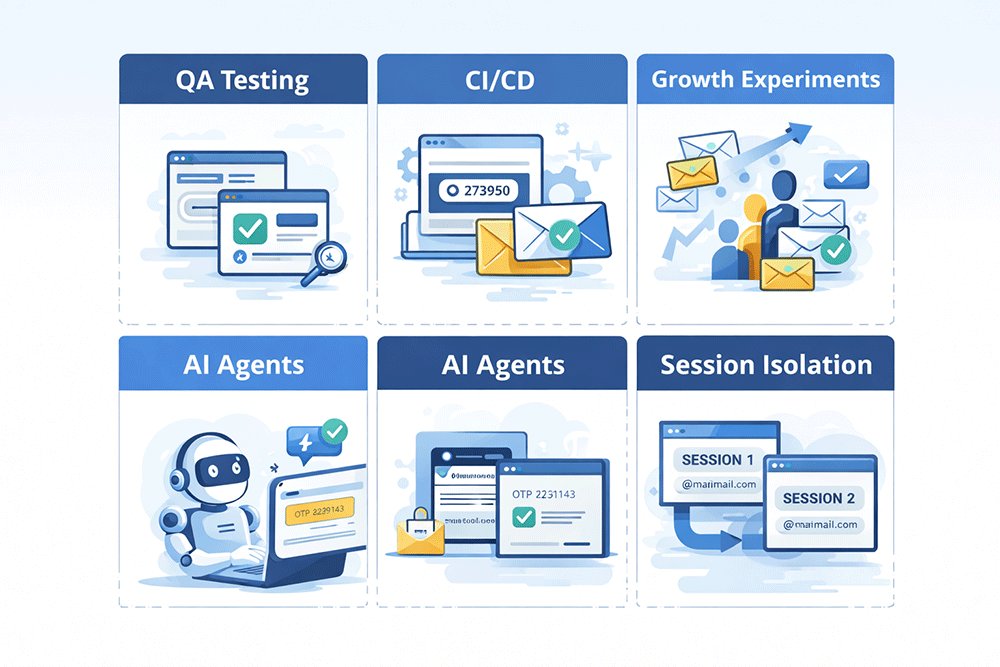
L'infrastructure d'e-mail jetable devient la plus précieuse lorsqu'elle est intégrée directement dans les flux de travail de développement et de test. Au lieu de traiter l'e-mail comme une dépendance externe, les équipes peuvent l'intégrer comme un composant contrôlé et répétable de leur pile d'automatisation. Voici quelques-uns des scénarios réels les plus courants où cette approche améliore la fiabilité et l'évolutivité.
Tests d'inscription automatisés
L'intégration d'une API pour contourner la vérification par e-mail dans Playwright ou Cypress vous permet de gérer l'ensemble du parcours utilisateur au sein d'un seul script de test. Au lieu de basculer entre les onglets du navigateur pour vérifier une boîte de réception manuelle, vous pouvez récupérer le code de vérification directement via un appel API, en maintenant la vitesse d'exécution de vos tests de navigateur sans tête (headless).
Pipelines QA de bout en bout
Dans les environnements CI/CD, valider qu'une application envoie réellement des e-mails est tout aussi critique que de confirmer les réponses API ou les transactions de base de données. Les programmes de recherche industrielle tels que ceux publiés par Google Cloud via ses initiatives DevOps Research and Assessment (DORA) soulignent que les équipes performantes intègrent la validation automatisée directement dans les pipelines de livraison pour réduire les taux d'échec et accélérer les cycles de rétroaction.
Une API de test d'e-mail permet aux flux de travail QA de provisionner des boîtes de réception jetables dynamiquement lors des déploiements de staging, de vérifier la livraison des messages, d'extraire les liens de confirmation et de poursuivre l'exécution sans intervention humaine. En intégrant la validation des e-mails dans la même couche d'automatisation utilisée pour les builds et les tests — généralement orchestrée via des plateformes comme GitHub Actions ou des systèmes CI similaires — les équipes éliminent les vérifications manuelles des boîtes de réception et réduisent les délais non déterministes. Cette approche renforce la vérification par e-mail de l'automatisation QA, garantissant que les flux d'identité et de notification sont testés en continu parallèlement à la logique applicative, permettant aux défauts de faire surface plus tôt dans le cycle de vie de la version et améliorant la confiance globale dans le déploiement.
Automatisation des expériences de croissance
Les équipes produit et croissance ont souvent besoin de simuler des flux d'onboarding, des systèmes de parrainage ou des scénarios multi-comptes pour analyser le comportement de conversion. Ces expériences nécessitent de grands volumes d'identités uniques, ce qui peut être difficile à gérer avec des systèmes d'e-mail persistants. Les boîtes de réception jetables permettent une simulation de compte évolutive tout en conservant des jeux de données propres pour l'analyse. Avec les tests d'identité jetables, les équipes peuvent mener des expériences contrôlées, réinitialiser les environnements instantanément et éviter les résidus de données à long terme que crée l'utilisation traditionnelle des e-mails.
Flux de travail des agents IA et des bots
À mesure que les systèmes autonomes et les outils pilotés par l'IA interagissent de plus en plus avec les plateformes web, ils doivent être capables d'effectuer des étapes de vérification par e-mail sans implication humaine. Une boîte de réception programmable permet de recevoir des e-mails par programmation, permettant aux agents de récupérer des mots de passe à usage unique ou des liens d'activation dans le cadre de leur logique d'exécution. Cette capacité prend en charge le traitement des e-mails par automatisation IA, où la vérification devient juste un autre événement lisible par machine dans un flux de travail décisionnel plus large.
Boîte de réception jetable par session
Pour les environnements de test parallèles, le maintien d'une isolation stricte entre les sessions est critique. Une approche basée sur la session permet à chaque flux de travail de générer sa propre adresse, de traiter le courrier entrant et de détruire la boîte de réception une fois la tâche terminée. Ce cycle de vie de boîte de réception isolée empêche la contamination croisée entre les tests et assureaucune fuite d'état entre les exécutions simultanées. Grâce à la génération d'e-mails basée sur les sessions, les équipes de développement obtiennent un comportement prévisible, même lors de l'exécution de suites de tests distribuées à grande échelle.
Comment fonctionne l'API d'e-mails temporaires : Aperçu d'une architecture sans état
D'un point de vue architectural, une API d'e-mails temporaires fonctionne moins comme un service de messagerie que comme une ressource programmable à la demande. Elle fournit une couche légère et éphémère conçue pour s'intégrer aux systèmes distribués modernes.
1. Le cycle de vie du provisionnement et de l'injection
Le processus commence par le provisionnement de boîtes de réception à la demande. Au lieu de gérer des comptes préconfigurés, votre application déclenche un appel API pour générer dynamiquement une identité unique. Cette adresse est immédiatement injectée dans votre flux de travail (par exemple, un formulaire d'inscription ou une étape d'authentification), garantissant que chaque session de test reste totalement isolée. Comme chaque identité est liée à un contexte d'exécution spécifique, il n'y a aucun risque de fuite de données ou de contamination croisée entre les tests.
2. Stratégie de récupération : Interrogation (Polling) vs Webhooks
La phase la plus critique pour les performances est la manière dont votre système récupère le message entrant. Une API de niveau entreprise propose deux modèles distincts qui impactent directement la latence de votre pipeline :
- Interrogation API (Modèle Pull) : Votre script demande à plusieurs reprises le statut de la boîte de réception à des intervalles définis. Bien que simple à mettre en œuvre, cela introduit une surcharge de "temps d'attente" et des requêtes réseau redondantes.
- Webhooks (Modèle Push) : C'est la référence pour l'automatisation haute performance. Dès que le serveur SMTP reçoit l'e-mail, l'API "pousse" les données vers votre point de terminaison d'écoute. Cela réduit la latence de vérification de quelques secondes à quelques millisecondes, permettant à votre pipeline CI/CD de continuer instantanément.
| Stratégie | Vitesse de livraison | Efficacité réseau | Meilleur cas d'utilisation |
|---|---|---|---|
| Polling | Dépend de l'intervalle | Modérée (requêtes redondantes) | Scripts simples / Faible fréquence |
| Webhooks | Quasi temps réel | Élevée (événement unique) | CI/CD à haute concurrence |
Contrairement aux fournisseurs temporaires qui perdent les données après un rafraîchissement, notre API prend en charge les boîtes de réception protégées par mot de passe, permettant à votre équipe de réaccéder à des comptes éphémères pour des tests de régression complexes sans compromettre l'isolation de l'identité.
3. Analyse programmatique et logique de déclenchement
Une fois le message capturé, la couche d'analyse du contenu transforme le corps de l'e-mail non structuré en JSON lisible par machine. Cela permet à votre framework d'automatisation d'extraire par programmation des mots de passe à usage unique (OTP) ou des liens d'activation. Une fois les données consommées, le pipeline d'automatisation reprend sans intervention humaine, menant le test ou la simulation utilisateur à son terme.
4. Suppression automatique (Nettoyage de l'état)
Enfin, la boîte de réception entre dans le cycle de destruction éphémère. L'identité et ses données associées sont automatiquement purgées, garantissant qu'aucun état résiduel ne subsiste. Cette conception sans état s'aligne parfaitement avec l'infrastructure conteneurisée et l'exécution parallèle, car il n'y a aucun stockage à maintenir ni aucune boîte aux lettres à gérer au fil du temps.
La fiabilité d'un pipeline de livraison dépend de la réputation du serveur de messagerie sous-jacent. Un fournisseur de haute qualité garantit des enregistrements MX propres pour les domaines d'e-mails temporaires afin d'éviter que les messages entrants ne soient limités ou retardés. Pour les développeurs, cela fait la différence entre un test qui réussit en 2 secondes et un autre qui expire en raison du "greylisting".
API d'e-mails temporaires vs Solutions d'e-mail traditionnelles
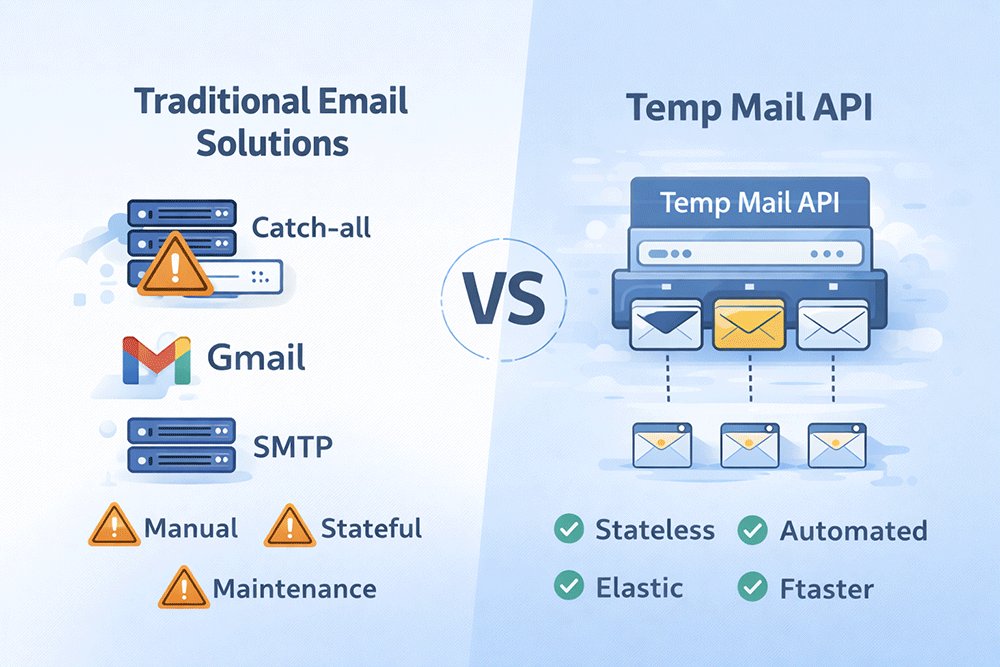
L'automatisation des flux d'e-mails avec des solutions traditionnelles crée souvent plus de problèmes qu'elle n'en résout. Le défi pour les développeurs n'est pas seulement d'envoyer ou de recevoir des messages, mais d'intégrer de manière fiable la vérification des e-mails dans des systèmes évolutifs et automatisés sans introduire de surcharge opérationnelle inutile.
| Méthode | Défis clés | Pourquoi cela échoue pour l'automatisation |
|---|---|---|
| Domaines Catch-all | Nécessite une gestion MX, une logique d'analyse et du stockage | Ajoute une charge d'infrastructure ; difficile à mettre à l'échelle pour les tests parallèles |
| Automatisation Gmail | Limites de débit, CAPTCHA, détection anti-bot | Optimisé pour un usage humain, pas pour l'automatisation ; peu fiable pour les flux CI/CD |
| SMTP auto-hébergé | Configuration serveur, gestion du spam, maintenance | Coût de maintenance élevé ; détourne les équipes du développement principal |
| API d'e-mails temporaires | Provisionnement à la demande, cycle de vie éphémère | Sans état, évolutif horizontalement, totalement isolé ; adapté aux pipelines d'automatisation |
Les approches traditionnelles obligent les équipes d'ingénierie à maintenir une infrastructure plutôt qu'à se concentrer sur les tests ou le développement. L'interrogation à haute fréquence, la création de comptes par script ou les boîtes aux lettres partagées peuvent rapidement créer des goulots d'étranglement, rendant les pipelines CI/CD fragiles.
En revanche, une API d'e-mails temporaires agit comme un système de messagerie élastique et convivial pour l'automatisation. Les boîtes de réception sont générées à la demande, les messages peuvent être reçus par programmation via polling ou webhooks, et la nature jetable de chaque boîte garantit des flux de travail isolés et sans état. Les développeurs n'ont plus besoin de gérer des comptes de messagerie persistants, et l'e-mail devient un composant programmable entièrement intégré aux frameworks de test, à l'automatisation pilotée par l'IA et aux pipelines CI/CD.
En fin de compte, les équipes ne devraient pas gérer des serveurs de messagerie juste pour tester un flux d'inscription. L'utilisation d'une API d'e-mails jetables offre une solution évolutive et sans maintenance, permettant aux développeurs de se concentrer sur la création de logiciels fiables tout en rationalisant les alternatives d'infrastructure de messagerie dans les flux de travail automatisés.
En d'autres termes, les équipes peuvent créer des centaines de boîtes de réception en quelques minutes sans gérer de serveurs, contrairement aux systèmes de messagerie hérités.
Quand une API d'e-mails temporaires n'est pas adaptée à la production ou à la conformité
Bien qu'une API d'e-mails temporaires soit un excellent outil pour l'automatisation et les tests, elle ne convient pas à tous les cas d'utilisation liés aux e-mails. Sa conception est optimisée pour les flux de travail éphémères basés sur des sessions, et non pour la communication à long terme ou les environnements de production. L'utiliser en dehors de son objectif prévu peut compromettre la fiabilité, la conformité et l'expérience utilisateur.
Les systèmes d'identité de production nécessitent des comptes de messagerie persistants et auditables. Une boîte de réception jetable ne peut pas prendre en charge de manière fiable la récupération de compte, les réinitialisations de mot de passe ou les notifications transactionnelles, ce qui la rend inadaptée à toute gestion d'identité critique en production.
La communication transactionnelle à long terme — telle que les confirmations de commande, les mises à jour d'abonnement ou les avis de facturation — dépend d'adresses e-mail stables et permanentes. Les adresses temporaires ne persistent pas et peuvent entraîner la perte de messages ou la confusion des clients.
La messagerie soumise à la conformité est un autre scénario où les API d'e-mails temporaires échouent. Les secteurs soumis à des normes légales ou réglementaires, tels que la finance, la santé ou les flux de travail conformes au RGPD, exigent que les enregistrements d'e-mails soient conservés et traçables. Les boîtes de réception éphémères ne peuvent pas répondre à ces obligations.
L'e-mail du cycle de vie client — y compris les séquences d'intégration, les campagnes marketing et les notifications personnalisées — repose sur des canaux de communication cohérents. L'utilisation d'un système jetable ici briserait l'engagement et créerait une expérience négative.
En bref, une API d'e-mails temporaires doit être traitée strictement comme un outil d'infrastructure de test et d'automatisation. Lorsqu'elle est appliquée dans son contexte prévu, elle améliore l'efficacité, l'évolutivité et la fiabilité. En dehors de ces scénarios, cependant, les solutions d'e-mail traditionnelles restent le seul choix sûr et conforme.
Exemple de flux de travail d'intégration
L'intégration d'une API d'e-mails temporaires dans un flux de travail automatisé ne consiste pas tant à écrire du code qu'à comprendre comment l'e-mail peut devenir un composant entièrement programmable au sein de la pile d'automatisation. Conceptuellement, le flux de travail suit une séquence d'étapes de gestion de boîte de réception éphémère, chacune alignée sur une phase spécifique du test ou de l'automatisation.
- Provisionnement de la boîte de réception
Au début d'un test ou d'une session, le système demande une nouvelle boîte de réception. Cette étape de provisionnement s'intègre naturellement dans la phase de configuration du test, garantissant que chaque exécution commence avec une identité d'e-mail propre et isolée. En générant des adresses à la demande, les équipes peuvent faire évoluer les tests horizontalement sans se soucier des collisions ou de l'état partagé. - Injection de l'adresse dans le flux de travail
L'e-mail nouvellement généré est inséré dans l'application cible, comme un formulaire d'inscription, un appel API ou un flux d'intégration. Comme la boîte de réception est éphémère, elle n'existe que pour la durée de cette tâche, permettant aux processus automatisés de se poursuivre sans laisser de données persistantes. - Surveillance par polling ou webhook
À mesure que les messages arrivent, le système les récupère via des points de terminaison de polling ou des notifications webhook. Cela s'aligne sur la logique de vérification asynchrone, permettant aux pipelines automatisés de se poursuivre dès que le contenu de l'e-mail pertinent est disponible. - Analyse du contenu
Les messages récupérés sont analysés pour extraire des liens de vérification, des mots de passe à usage unique ou des données structurées. Cette étape transforme l'e-mail d'un point de contrôle manuel en une entrée lisible par machine, permettant une prise de décision automatisée. - Déclenchement de la logique de continuation
Une fois les données requises extraites, les étapes d'automatisation en aval — telles que l'activation de compte, les validations de test ou les transitions de flux de travail — peuvent se poursuivre immédiatement, maintenant un pipeline fluide et continu. - Destruction et nettoyage de la boîte de réception
Enfin, la boîte de réception est supprimée dans le cadre du cycle de vie de la boîte jetable, empêchant la persistance des données et maintenant l'isolation pour les exécutions de test ultérieures.
En visualisant l'e-mail comme une ressource modulaire et éphémère plutôt que comme un service statique, ce flux de travail démontre comment une API d'e-mails temporaires s'intègre de manière transparente.dans les pipelines CI/CD, les frameworks de test et les systèmes d'intégration automatisés, renforçant ainsi son rôle de composant d'infrastructure technique et pédagogique.
Avantages de l'utilisation d'une API d'e-mail jetable
Dans les flux de travail modernes de développement et d'assurance qualité (QA), l'API best disposable email offre des avantages techniques tangibles qui vont bien au-delà de la simple commodité. L'un de ses principaux avantages est l'élimination de l'état partagé lors des tests. Chaque exécution de test fonctionne avec une boîte de réception totalement isolée, garantissant que les messages d'une session n'interfèrent pas avec une autre. Cela assure des résultats déterministes et évite les collisions de données dans les scénarios de tests parallèles ou répétés.
Un autre avantage clé est la possibilité de permettre une simulation d'identité évolutive horizontalement. Les équipes peuvent créer des centaines, voire des milliers d'adresses temporaires à la demande, prenant en charge les tests de charge, les expériences d'intégration ou les simulations multi-comptes sans infrastructure supplémentaire. Cette capacité contribue directement à des flux de travail de test évolutifs, permettant aux équipes d'ingénierie de tester efficacement la résistance des systèmes.
En tirant parti d'une API d'e-mail jetable, les organisations se libèrent également du fardeau lié à la gestion d'une infrastructure d'e-mail. Il n'est plus nécessaire de maintenir des serveurs, de gérer le stockage, de traiter le filtrage du spam ou de mettre en œuvre des politiques de rétention. Cette couche d'e-mail sans maintenance libère des ressources pour les tâches de développement principales tout en réduisant la complexité opérationnelle.
L'intégration de boîtes de réception éphémères dans les pipelines CI/CD accélère également les boucles de rétroaction. Les tests automatisés peuvent valider la réception des e-mails, extraire les liens de vérification et faire avancer les flux de travail sans intervention manuelle, améliorant ainsi l'efficacité globale de l'automatisation et permettant des cycles d'itération plus rapides.
Enfin, les API d'e-mail jetables favorisent l'expérimentation respectueuse de la vie privée. Étant donné que chaque boîte de réception n'existe que pour un test ou une session spécifique, il n'y a pas de stockage à long terme d'informations sensibles, ce qui réduit les risques et garantit la conformité avec les directives internes en matière de confidentialité.
Ensemble, ces avantages démontrent comment le traitement de l'e-mail en tant que composant programmable et jetable transforme les tests et l'automatisation d'une dépendance fragile en un processus prévisible, évolutif et sécurisé.
Foire aux questions sur l'API Temp Mail
Commencez avec notre API Temp Mail pour vos flux de travail de test automatisés
Arrêtez de gérer des serveurs de messagerie hérités et commencez à faire évoluer vos tests. L'API TempEmail.cc est conçue pour remplacer les flux de travail d'e-mail fragiles et centrés sur l'humain par une couche d'infrastructure haute performance et sans état. En déplaçant votre vérification d'e-mail vers notre pool de domaines propres préconfiguré, vous éliminez le casse-tête constant de la mise sur liste noire des domaines sur des plateformes comme Google, Discord et les principaux fournisseurs SaaS.
Que vous automatisiez un simple flux d'inscription ou que vous orchestriez un réseau massif de bots pilotés par l'IA, notre API fournit l'isolation et la fiabilité nécessaires pour des tests 100 % déterministes. Chaque boîte de réception est éphémère, chaque requête a une faible latence et chaque intégration est conçue pour vivre à l'intérieur de votre pipeline CI/CD — non pas comme une dépendance externe, mais comme une ressource programmable.
Prêt à éliminer vos goulots d'étranglement en matière d'automatisation ?